Contents +
Give a competent engineer a specification in 2019 — live wildfire tracking, satellite hotspots, a wind-driven spread model, aircraft positions, a public site that survives a traffic spike — and he will give you back a plan: four people, two quarters, a few hundred thousand euros, and a steering committee to explain the slip. Give the same specification to the same engineer in 2026, and he will give you back the site. It takes a long weekend, alone, and the largest line item is coffee.
Now ask both engineers the second question: who buys it? Watch the difference vanish. The 2026 engineer has no better answer than the 2019 one. The collapse in the cost of building did not touch the cost of selling. It only made the gap between them visible — and the gap, it turns out, was most of the business all along.
I know because I ran the experiment. This essay is about what happens when trying becomes nearly free — and about where the cost went, because it did not disappear.
Three things change when building costs a weekend
The order inverts. For seventy years the sequence was: convince, fund, build, learn. The prototype was the milestone that justified the spend, so you needed conviction before you needed code. When a working product costs a weekend, the sequence flips: build, learn, then decide whether anyone needs convincing. Software moves from capital expenditure to option premium — a small, non-refundable payment for the answer to a question. The correct number of speculative builds used to be approximately zero. It is not anymore.
The window opens. There is a whole category of software that was never irrational to want, only irrational to fund: too temporary, too local, too small to amortise a team. A forest fire lasts three weeks. No 2019 roadmap survives that arithmetic, which is why event-speed software mostly did not exist — not because nobody needed it, but because the build cost outlived the need. At weekend cost, the arithmetic inverts, and the catalogue of buildable things suddenly includes everything that used to be too small or too brief to bother with.
The moat moves. When anyone can produce the artifact, the artifact stops carrying information. A working demo used to be a costly signal — proof of team, capital, endurance. Now it proves a weekend. Scarcity does not vanish; it relocates to what a model cannot generate: distribution, institutional trust, proprietary data, the right to bear liability, and timing. For anyone allocating capital, the practical translation is blunt: the demo used to be the diligence. Now the demo is table stakes, and the diligence moves to the boring parts.
A fire, a weekend, three clocks
In July 2026 the Gironde burned — roughly forty-two thousand hectares across three fronts, some two hundred thousand people evacuated at the peak. I am from the region. The public information environment was prefecture communiqués hours apart, and screenshots circulating faster than the facts inside them.
So I built the thing the moment seemed to ask for: satellite hotspots refreshed from NASA's fire-detection feeds, Météo-France wind at 1.3-kilometre resolution, water-bomber positions from their transponders, and a spread projection labelled, in so many words, if nothing changes. It ran on an edge worker; the hosting bill was tens of euros. Two details mattered more than any feature. The model published its own error — it had overestimated spread by about fifteen percent across the four comparisons that could be checked — and a permanent banner stated that this was information, not instruction: the prefecture's word takes precedence, the emergency number is 112.
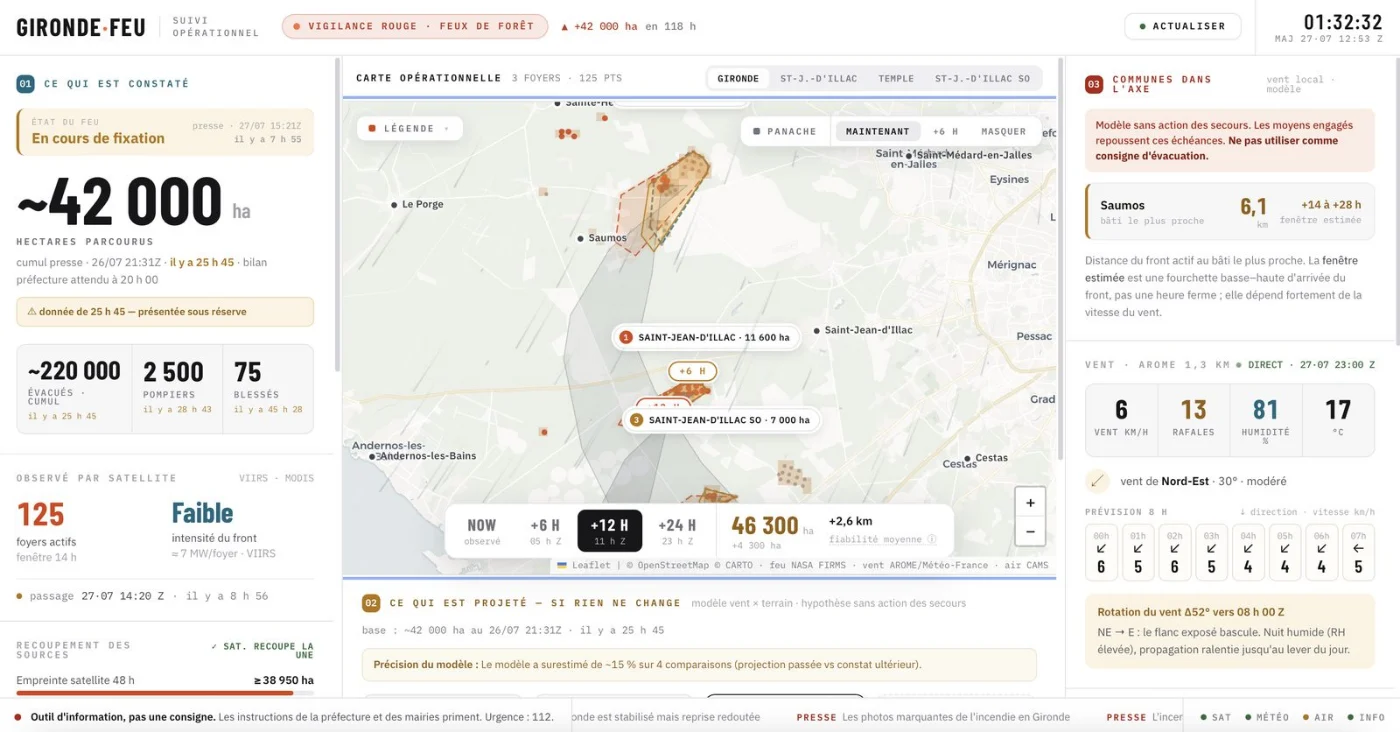
Then the second question. I took it to leading French broadcasters, with a simple structure in mind: licence the feed, exclusive to one channel per news segment, priced against what a graphics team costs. And here is the part worth your time: nobody disputed the product. Not one conversation was about whether the map was good. Every conversation was about everything else, and the everything else sorted into three clocks.
The first clock is editorial responsibility. A broadcaster that airs a projection cone owns the cone. If a household stays put because the +24-hour line sat one commune short, the question in the inquiry is not "whose model?" — it is "why did you broadcast it?" Institutions are not slow because they are stupid. They are slow because they are the ones who bear the outcome, and bearing outcomes is precisely the service they sell.
The second clock is verification. To a newsroom, an unknown builder with a working site is indistinguishable, at first contact, from the hundred other unknown builders with working sites — and AI is manufacturing more of us every week. The cheaper the artifact, the more the buyer's cost shifts to filtering, which means the value of already being trusted goes up, not down.
The third clock is procurement, and it is the simplest: a contract moves in months and a fire moves in hours. There was also a fourth clock on my own side of the table — my employer's compliance sign-off before the first commercial email could leave my outbox. Sellers carry institutions too.
The fire was contained before any of those clocks finished ticking. The code is now worth approximately nothing — and that is not the failure it sounds like. The weekend bought a precise, personally verified map of where the value in this market actually sits. It sits nowhere near the code.
The cost did not disappear. It moved.
Every input to that build was public and free — the satellite feed, the weather model, the transponders. The engineering premium that would have justified a company in 2019 has gone to zero, and what remains priced is exactly what the three clocks measure: the right to be believed, the channel to be seen, and the balance sheet to be wrong on.
Read that as an investor and the screening logic inverts. A working product at seed now screens nothing — it is a weekend, by definition. The questions that price the deal are the old unfashionable ones, back with compound interest: who owns the distribution, who holds the data that is not public, who is structurally allowed to bear the liability, and can this team move at the window's speed institutionally — not once, heroically, but every time, contractually. If the opportunity is event-shaped, the company was never "an app per fire." It is the standing rails — pre-cleared procurement, editorial protocol, a liability wrapper — that let the next weekend build go live inside an institution in hours instead of months. The rails are the venture. The app is the demo of the rails.
And read it as a builder and the discipline is the same in miniature. Write the question before the code: a weekend build's real deliverable is information, so state in one line what the artifact is supposed to prove, or you will mistake shipping for learning. Attach to the constraint first: if the plan is "build, then find distribution," the plan defers the hard part — the channel can be courted before the event; the artifact can wait a weekend, the relationship cannot. And when the option expires worthless, collect the information it bought. That was always the product.
Conclusion
The order, inverted. The window, open. The moat, moved. AI did not make software valuable — it made attempts cheap, and in doing so it repriced everything an attempt cannot manufacture: the channel, the trust, the right to be wrong in public.
The strange consequence is that the most technical shift in the economics of software makes the decisive assets less technical than they have ever been. When everyone can conjure the artifact, the companies worth building — and worth backing — are the ones that own what the weekend cannot produce.
That is what the weekend was trying to tell me. The artifact was free. The asset was never the artifact.